The Problem with the Darwin Fish
Thoughts from the Radical Left

I should not have laughed when I first saw the Darwin Fish, probably back in the mid 1980s, on the rear of some random person’s car. It was wrong for me to have laughed, and it was doubly wrong for the owner of that car. We both erred and now we are reaping what we have sown.
I often scratch my head when I read of the right’s scorn for elitist institutions, like colleges, for instance. How in the world could a mediocre history professor at a state college in upstate New York ever be characterized as an elitist? I have no real power and precious little influence. I live in a neighborhood that is filled with people who make a living in the prison system and the local hospital. In no uncertain terms, I don’t see myself as superior to any of the people who I consider my neighbors. I certainly don’t act that way, that I know of. But I did laugh at the Darwin Fish (I don’t anymore).
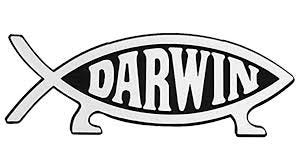
The Jesus Fish started appearing on cars in the mid 1970s. I don’t know where or how they became popular. Or why. At an absolute minimum, we can safely assume that the owner of a Jesus Fish car wants to convey a message to other drivers: “I am a Christian.” That’s it. It may be worth speculating why the car-owner feels the need to identify himself as a Christian, but it really doesn’t matter. It took about a decade for the Darwin Fish to evolve. The Darwin Fish car’s driver is conveying several things at the same time—this is the nature of parody. First, “I believe in science/evolution.” If this was the only message, he’d be fine. But it’s not. He is also saying something about the Jesus Fish driver, maybe even to the Jesus Fish driver: “You don’t believe in science/evolution.” “You believe in faith over fact.” “You are a premodern, uneducated rube blindly swearing allegiances to spirits in the sky.” “You are stupid.” Putting Richard Dawkins in the trunk with a bullhorn would have a similar effect. You see the problem. When you compare the moral value of both fish symbols, it’s very clear who is standing on higher ground. I shouldn’t have laughed.

There is a long history of science belittling faith. Clarence Darrow’s dressing down of William Jennings Bryan at the Scopes Trial comes immediately to mind. But I don’t think that’s the important take-away of the fish comparison. There’s too much evidence of atheists getting along with people of faith; the whole science versus religion thing is mostly played out. No, the real problem—other than being needlessly aggressive—happened when the Darwin-fish prophet of science conveyed multiple and even complicated ideas with a little symbol. As a result, the Christian reader of the Darwin-fish driver is likely left feeling a little confused and a lot trodden upon: “I don’t know exactly what he’s saying, but I do know that he’s making fun of me.” A little anti-secular-elitism kind of makes sense.
Clearly, we don’t want to explain the complexity of populism’s beef with elite institutions (government / science / medicine / education) as a result of the Darwin Fish. It’s complicated; I get it. But it doesn’t help matters when people like me, who have been less hurt by neo-liberalism, provoke the ire of its victims. The objectives of “Black Lives Matter” are just and necessary, but the simple slogan, “Black Lives Matter” was always going to divide a country at a moment that called for a bit more conversation. I understand and appreciate the goals of “Defund the Police,” (maybe we can even start paying social workers better) but that simple rallying cry conveys multiple messages that are divisive. Do I even need to bring up “From the River to the Sea”? Even though I truly believe that most of the complicated messages ungirding these slogans are just, they often alienate, belittle and sometimes attack the people we need to convince.
There is the counter-argument that the modern criminal justice reform movement needed the meme-ish nature of these rallying cries in order to go viral, and thus to become a movement. Maybe these rallying cry’s needed to be outwardly focused to highlight the structures that are oppressing. There may be some truth here. But only a bit. In the end, ACAB—another example—is intended to say that there is racism inherent in the criminal justice system. Fair and true. But it also says that individual people who enforce laws are all bad. This is not true and it alienates all of the fair-minded cops who are trying to reform the system. I completely understand the impulse to coin a rallying meme. If I understand correctly, it is borne out of a hatred and frustration with a system, a system that we rely on, but also has elements that have been cruel and unjust for far too long. And when the meme goes viral, it provides a powerful unifying force. But it also divides, and by doing so it undermines the reform it seeks to achieve.
Is there an alternative? Look, for example, at some of the signs held by protesters at the March on Washington in 1963, the culmination of America’s most successful civil rights protest. “We Demand: An End to Bias Now!” “We Demand: Decent Housing Now!” “We March for Integrated Schools Now!” “We Demand: Equal Rights Now!” Now, these are loud and forceful slogans, but they are not so outwardly directed as the Darwin Fish or ACAB. They were designed to capture the attention and court the favor of white America. They are aimed at a system, not at individual people. And they succeeded. Civil Rights Act. Voting Rights Act. And for the first time, America became a true democracy. More to the point, when I want students to understand the civil rights movement, I never use marching signs. We use speeches, sermons, articles, pamphlets and books—nothing that fits on a lawn-sign. And when King did need to be outwardly facing and call individual people to account he did so by writing a letter from a jail in Birmingham.

We are living in complicated times that require careful thought, deliberation, conversation and compromise. It is incumbent on those of us who belong to elite institutions to be better citizens. We can continue to support progressive and even radical causes, but we should refrain from turning those causes into memes that offer our critics an opportunity to react quickly and emotively. I need to have, and I have had, hard conversations with my neighbors who are part of the criminal justice system. Those conversations become much more difficult if they happen on the street with a sign stuck in my front lawn. I can believe and lean in to the cause without alienating my neighbor and I can understand the truth in evolution without deriding Christians. I should never have laughed at the Darwin Fish.